How to Read a Dog Food Label: The AAFCO Statement and What Matters
Learn to read a dog food label fast: find the AAFCO statement, compare on a dry-matter basis, decode the ingredient list, and ignore marketing fluff.
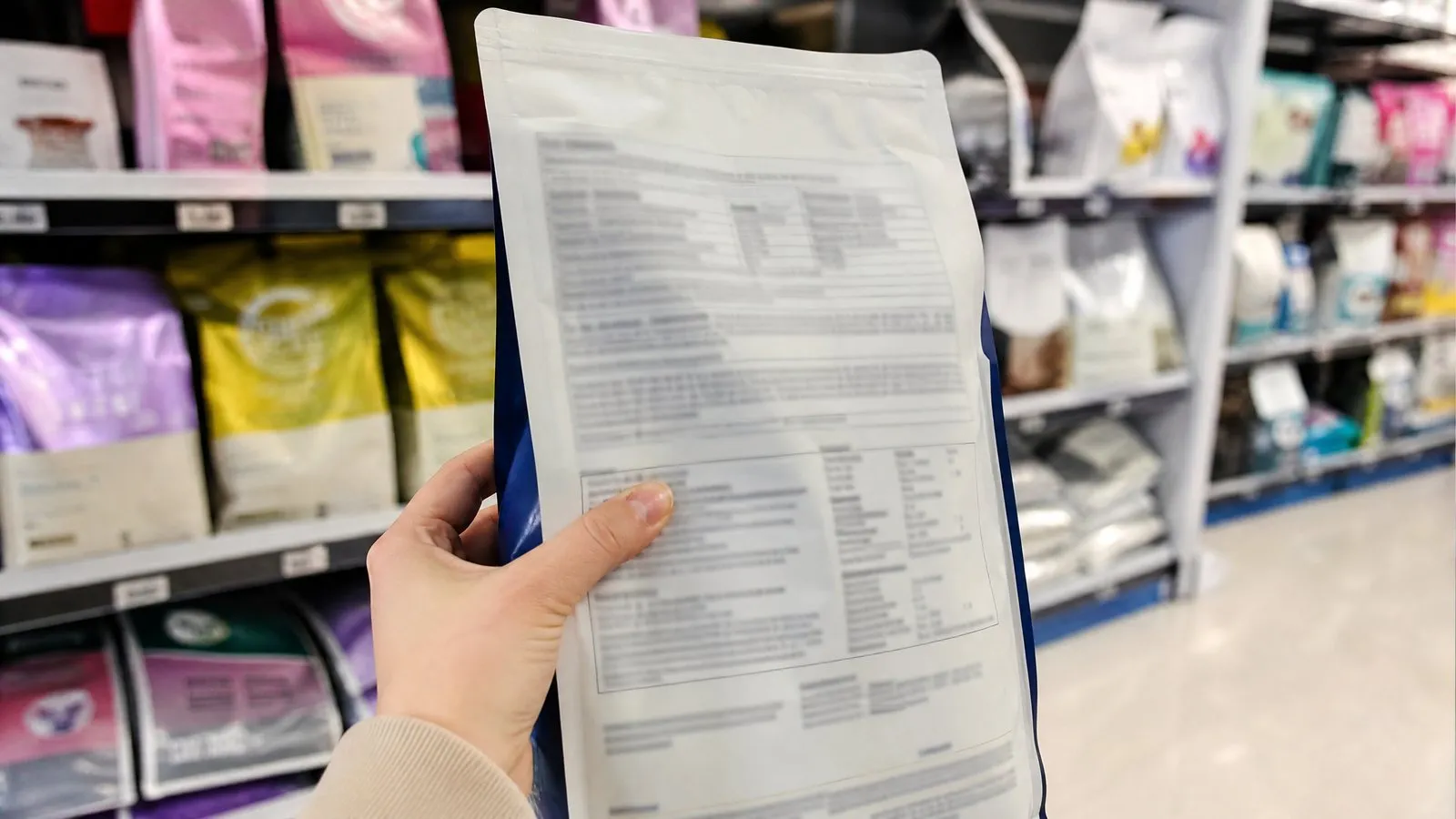
The single most useful line on any dog food package is the nutritional adequacy statement, usually in small print on the back or side. It tells you whether the food is actually complete and balanced, and for which life stage. Find that first, then check the calorie content and the guaranteed analysis. Everything on the front of the bag is marketing until you’ve read those three things.
Here’s how to read the whole label in a few minutes, and what you can safely ignore.
Start with the nutritional adequacy statement (the “AAFCO statement”)
In the US, this one sentence is the heart of the label. The Association of American Feed Control Officials (AAFCO) sets the model definitions that most states adopt, and reputable foods include a statement that references them. It usually reads something like:
“[Product] is formulated to meet the nutritional levels established by the AAFCO Dog Food Nutrient Profiles for…”
The last part is what matters. You’re looking for one of these life-stage phrases:
- Growth (puppies) or growth and reproduction — appropriate for puppies and pregnant or nursing dogs.
- Maintenance — for adult dogs only. A food labeled maintenance-only is not complete for a growing puppy.
- All life stages — meets the growth/reproduction requirements, so it’s suitable for puppies too. It’s essentially a puppy-grade food that adults can also eat.
There’s also a crucial extra clause for large-breed puppies. If you have a puppy expected to reach about 70 lb (around 32 kg) or more as an adult, look for wording that the food is suitable for “growth of large size dogs (70 lb or more as an adult).” Large-breed puppies need controlled calcium, and a food that omits this phrase may not be appropriate for them.
“Formulated to meet” vs “feeding tests”
The statement also hints at how the food was proven adequate:
- “Formulated to meet” means the recipe was designed on paper (and often lab-tested) to hit the nutrient profile.
- “Animal feeding tests using AAFCO procedures substantiate…” means the food was fed to actual dogs in a trial. Many professionals, including guidance echoed by the American Animal Hospital Association (AAHA), view feeding-trial substantiation as a slightly stronger standard.
Neither is a red flag on its own. But if a product has no adequacy statement at all, treat it as a treat, topper, or supplement, not a meal. The label may even say “for intermittent or supplemental feeding only” — that food should not be your puppy’s main diet.
UK, EU and Australia note: Labels there follow FEDIAF (the European pet food federation) nutritional guidelines rather than AAFCO. The idea is the same — look for wording that the food is a “complete” food (as opposed to “complementary”) for the right life stage, such as puppy/junior, adult, or all life stages.
Check the calorie content
Every complete US dog food must state its energy content as kcal per kilogram and usually kcal per cup or per can. This number matters more than most people realize, because foods vary widely — one kibble might be 320 kcal per cup and another 480.
Use it to:
- Compare foods honestly. A “cup” is not a standard dose of energy.
- Portion correctly. Feeding charts on bags are starting points and often run generous. Match the calories to your dog’s needs and body condition.
For working out how much your puppy actually needs, see How Much to Feed a Puppy: Calories and Cups by Age and Weight or run the numbers in our Puppy Food Calculator.
Understand the guaranteed analysis (and why dry matter matters)
The guaranteed analysis lists minimum or maximum percentages for a few key nutrients. In the US and under FEDIAF you’ll typically see:
- Crude protein (minimum)
- Crude fat (minimum)
- Crude fiber (maximum)
- Moisture (maximum)
“Crude” refers to the testing method, not quality. The catch is that these percentages include water, which makes comparing a dry kibble to a wet food completely misleading at first glance.
Why you can’t compare wet and dry directly
Dry food is around 10% moisture; canned food is often 78–82%. So a canned food’s “10% protein” and a kibble’s “26% protein” aren’t measuring the same thing. To compare fairly, convert both to a dry-matter basis — what’s left after you remove the water.
The simple method:
- Find the moisture percentage. Subtract it from 100 to get the dry matter.
- Divide the nutrient percentage by the dry matter.
- Multiply by 100.
Worked example — protein:
| Dry food | Canned food | |
|---|---|---|
| Crude protein (as fed) | 26% | 10% |
| Moisture | 10% | 80% |
| Dry matter (100 − moisture) | 90% | 20% |
| Protein, dry-matter basis | 26 ÷ 90 × 100 = 28.9% | 10 ÷ 20 × 100 = 50% |
On the label the kibble looks far higher in protein. On a dry-matter basis, the canned food actually has much more. Do this conversion whenever you’re comparing two foods, especially across formats.
One more honest note: the guaranteed analysis shows minimums and maximums, not exact amounts. A food guaranteeing “minimum 26% protein” might contain more. It’s useful for broad comparison, not precision nutrition.
Read the ingredient list correctly
Ingredients are listed by weight, heaviest first, including their water content. That rule creates two common points of confusion.
- Whole meats look impressive but are mostly water. Fresh chicken is roughly 70% water, so it’s heavy at the mixing bowl stage. After cooking, much of that weight disappears. A named meat meal (like “chicken meal”) is already dehydrated, so it can actually deliver more protein than fresh meat listed above it.
- Ingredient splitting can shuffle the order. A maker can split one ingredient into several entries — “ground corn,” “corn gluten meal,” “corn bran” — so each lands lower on the list, pushing meat up. Read the whole list, not just the first item.
What’s genuinely worth noting:
- Named protein sources (“chicken,” “lamb meal,” “salmon”) are more informative than vague terms like “meat” or “animal by-product.”
- By-products are not automatically bad. Organ meats are nutritious; the term just sounds unappealing. Named by-products are more transparent than unnamed ones.
- The list tells you what’s in the food, not how good it is. A beautiful ingredient list on a food with no AAFCO adequacy statement is still not a complete diet. Adequacy comes first; ingredients are secondary.
If your puppy has a diagnosed allergy or sensitivity, the ingredient list matters more, and it’s worth planning diet changes with your vet rather than guessing.
Marketing terms that mean little (or nothing)
A lot of front-of-bag language is unregulated or only loosely defined. Don’t let it drive your decision.
| Term | What it actually means |
|---|---|
| Premium, super-premium, gourmet, ultra | No legal definition. No guaranteed difference in quality. |
| Holistic | No regulatory definition for pet food. Marketing only. |
| Human-grade | Only allowed in the US if the entire product and facility meet human-food standards; often misused. Verify it’s a formal claim, not a slogan. |
| Natural | Loosely defined by AAFCO; roughly means no synthetic additives except added vitamins and minerals. Says nothing about quality or nutrition. |
| Grain-free | Simply no grains. Not healthier by default. The FDA has investigated a possible link between some grain-free diets and heart disease (DCM); the picture isn’t settled, so discuss it with your vet. |
| Made with real chicken | Requires only that some real chicken is present, not that it’s the main ingredient. |
| No fillers / no by-products | Marketing framing. “Fillers” has no legal meaning. |
The US “named ingredient” percentage rules
AAFCO does define how much of a named ingredient a product name implies. It’s quirky but useful:
- “Chicken Dog Food” — the named ingredient must be at least 95% of the product (excluding water).
- “Chicken Dinner / Entrée / Formula / Platter” — at least 25%.
- “With Chicken” — as little as 3%.
- “Chicken Flavor” — only enough to be detectable; there may be almost no actual chicken.
So “Beef Dog Food” and “Dog Food with Beef” are very different products.
A quick label-reading routine
Spend five minutes and you’ll know more than most shoppers:
- Find the adequacy statement. Confirm it’s complete and balanced for your dog’s life stage (growth or all life stages for puppies; add the large-breed clause if relevant).
- Check the calories per cup or can, so you can portion and compare.
- Scan the guaranteed analysis, and convert to dry matter if comparing formats.
- Read the whole ingredient list, looking for named proteins and watching for splitting.
- Ignore the front-of-bag adjectives unless they map to a defined claim.
When you’re ready to settle on amounts and meal timing, our guides on the Puppy Feeding Schedule and When to Switch From Puppy Food to Adult Dog Food take it from here. And if you’re still assembling the essentials, the New Puppy Checklist covers bowls, storage, and the rest.
When to involve your vet
Talk to your veterinarian before making a big diet decision if your puppy:
- Is a large or giant breed (calcium and growth control matter).
- Has a diagnosed health condition, allergy, or ongoing digestive upset.
- Loses or gains weight unexpectedly, or has poor coat or energy.
- Is on a homemade, raw, or restricted diet, where balancing nutrients is genuinely hard without professional input.
Your vet can also help you read a label in the context of your specific dog, which is something no bag can do.
FAQ
Is a food labeled “all life stages” okay for my puppy?
Yes. “All life stages” means the food meets AAFCO’s growth and reproduction requirements, so it’s suitable for puppies as well as adults. The one exception: large-breed puppies should look for the extra phrase about being suitable for “growth of large size dogs (70 lb or more as an adult).”
Does a higher protein percentage mean a better food?
Not necessarily, and the number on the bag can mislead you. Percentages in the guaranteed analysis include water, so you must convert to a dry-matter basis before comparing — especially between wet and dry foods. More protein also isn’t automatically better; what matters is a complete, balanced diet appropriate for your dog’s life stage.
Is grain-free food healthier?
There’s no evidence that grain-free is healthier for most dogs, and grains are not “fillers.” The FDA has looked into a possible association between certain grain-free diets and a heart condition (DCM), though the science isn’t settled. Unless your vet has diagnosed a specific grain issue, there’s no need to seek out grain-free.
What does it mean if there’s no AAFCO statement at all?
It means the food hasn’t been shown to be complete and balanced, so it shouldn’t be your dog’s main diet. Products like toppers, treats, or mixers often carry the line “for intermittent or supplemental feeding only.” Use them as extras, not meals.
How do UK and Australian labels differ?
They follow FEDIAF guidelines rather than AAFCO, but the logic is the same. Look for the word “complete” (a full diet) versus “complementary” (a partial food or treat), and check it’s labeled for the right life stage, such as puppy, junior, adult, or all life stages.
A note on health information: Health and nutrition guides are written against published guidance from the AAHA, WSAVA and AVMA. They are general information, not a substitute for advice from your own veterinarian. If your dog seems unwell, call your vet.