How Much to Feed a Puppy: Calories and Cups by Age and Weight
Learn how much to feed a puppy using calories and cups by age and weight, with the RER formula, puppy multipliers, a worked example, and body scoring.
Most puppies need roughly two to three times the calories of an adult dog their size, because they’re building bone, muscle, and organs fast. The quickest reliable way to get a starting number is to calculate your puppy’s resting energy requirement, multiply it by an age factor, then convert that calorie target into cups using the kcal-per-cup figure printed on your food bag.
Below is the exact math, a worked example, and how to adjust by watching your puppy’s body rather than the chart. If you’d rather skip the arithmetic, our Puppy Food Calculator does it for you.
Start with calories, not cups
“Cups” is the least reliable unit in dog feeding. A cup of one food might be 300 calories; a cup of another might be 480. That’s why two bags can give wildly different chart recommendations for the same puppy. Calories are the honest number, so we start there and convert to cups at the end.
Step 1: Find resting energy requirement (RER)
RER is the energy a body needs at rest. The standard formula used across veterinary nutrition is:
RER = 70 × (body weight in kg)^0.75
The ^0.75 exponent matters. Energy needs don’t scale in a straight line with weight, so you can’t just double the calories when a puppy doubles in size. You need the power function.
If your puppy is weighed in pounds, divide by 2.2 to get kilograms first.
Here’s RER for a range of weights so you can see the shape of it:
| Puppy weight | RER (kcal/day) |
|---|---|
| 2 kg (4.4 lb) | 117 |
| 5 kg (11 lb) | 234 |
| 10 kg (22 lb) | 394 |
| 20 kg (44 lb) | 662 |
| 30 kg (66 lb) | 898 |
Step 2: Apply the puppy multiplier
A growing puppy burns far more than rest. Mainstream veterinary guidance, including the approach taught by the American Animal Hospital Association, uses growth multipliers that step down as the puppy matures:
- Under 4 months old: about 3 × RER
- 4 months to adult size: about 2 × RER
Once your dog reaches full adult size and is spayed or neutered, maintenance typically drops to around 1.6 × RER, and often lower for less active dogs. That’s one reason feeding amounts should fall over time, not keep climbing.
These are starting points, not guarantees. Very active working-breed puppies may need more; mellow or small-breed puppies often need less.
A worked example
Let’s feed a 5 kg (11 lb) puppy who is 3 months old.
- RER = 70 × 5^0.75 = 70 × 3.34 = 234 kcal/day
- Under 4 months, so × 3: 234 × 3 = 702 kcal/day
- Convert to cups. Check the bag for kcal per cup. Say it reads 350 kcal/cup. 702 ÷ 350 = 2.0 cups per day
Now split that across meals. At three months, most puppies eat three meals a day, so that’s about two-thirds of a cup per meal. For how meal frequency changes with age, see our puppy feeding schedule.
Same puppy, different food
Swap to a more calorie-dense food at 450 kcal/cup, and the math changes:
702 ÷ 450 = 1.6 cups per day
Same puppy, same calories, but almost half a cup less food. This is exactly why copying a friend’s cup amount, or reusing the number from your last bag, can quietly over- or underfeed your dog.
Why kcal per cup is the number that changes everything
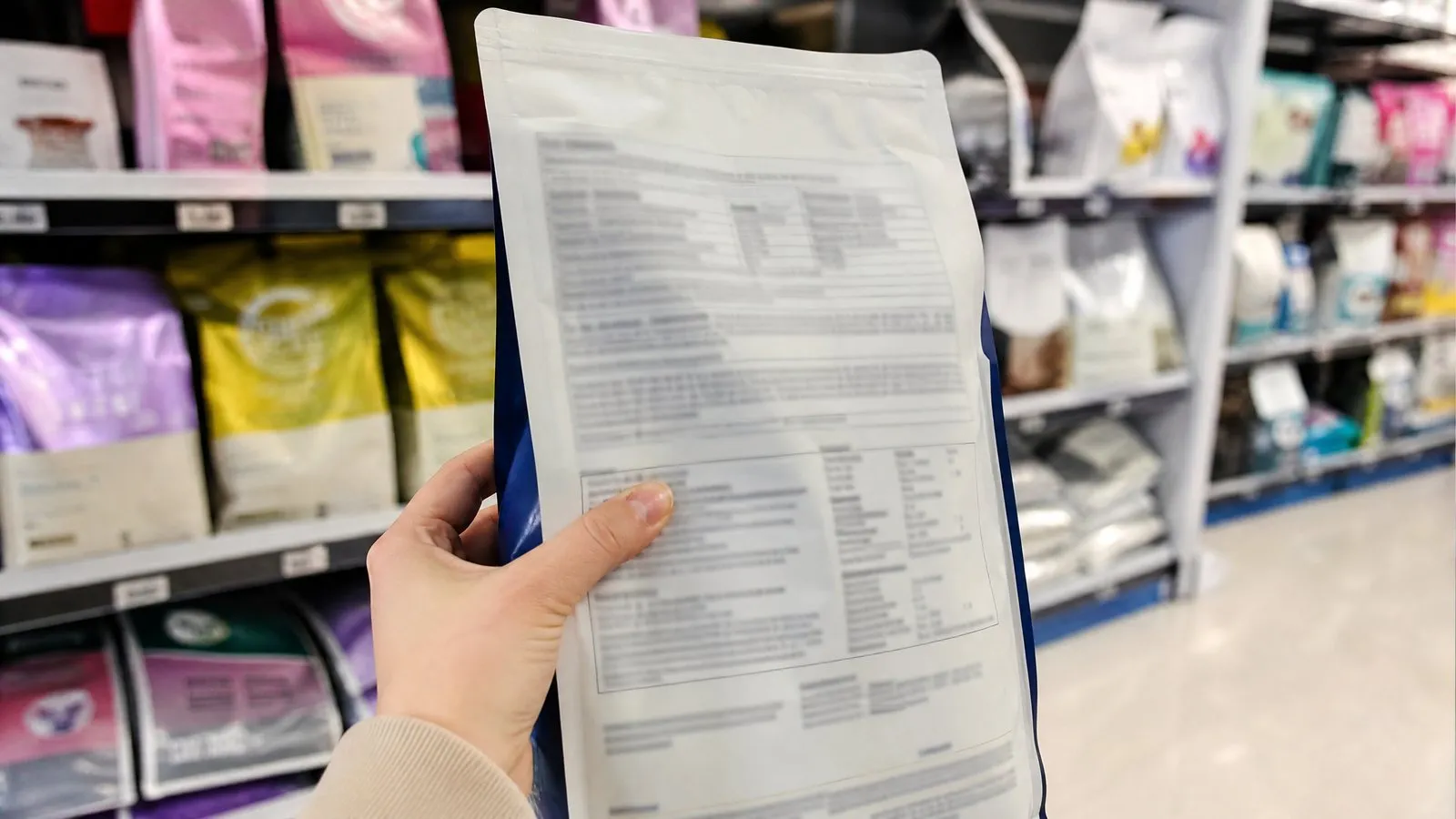
Every complete dog food in the US, UK, Canada, and Australia lists a calorie content (often called metabolizable energy, or ME). In North America it’s usually shown as kcal per cup and kcal per kg. In the UK, Europe, and Australia you’ll more often see kcal per 100 g, which is actually easier to use with a kitchen scale.
Two practical takeaways:
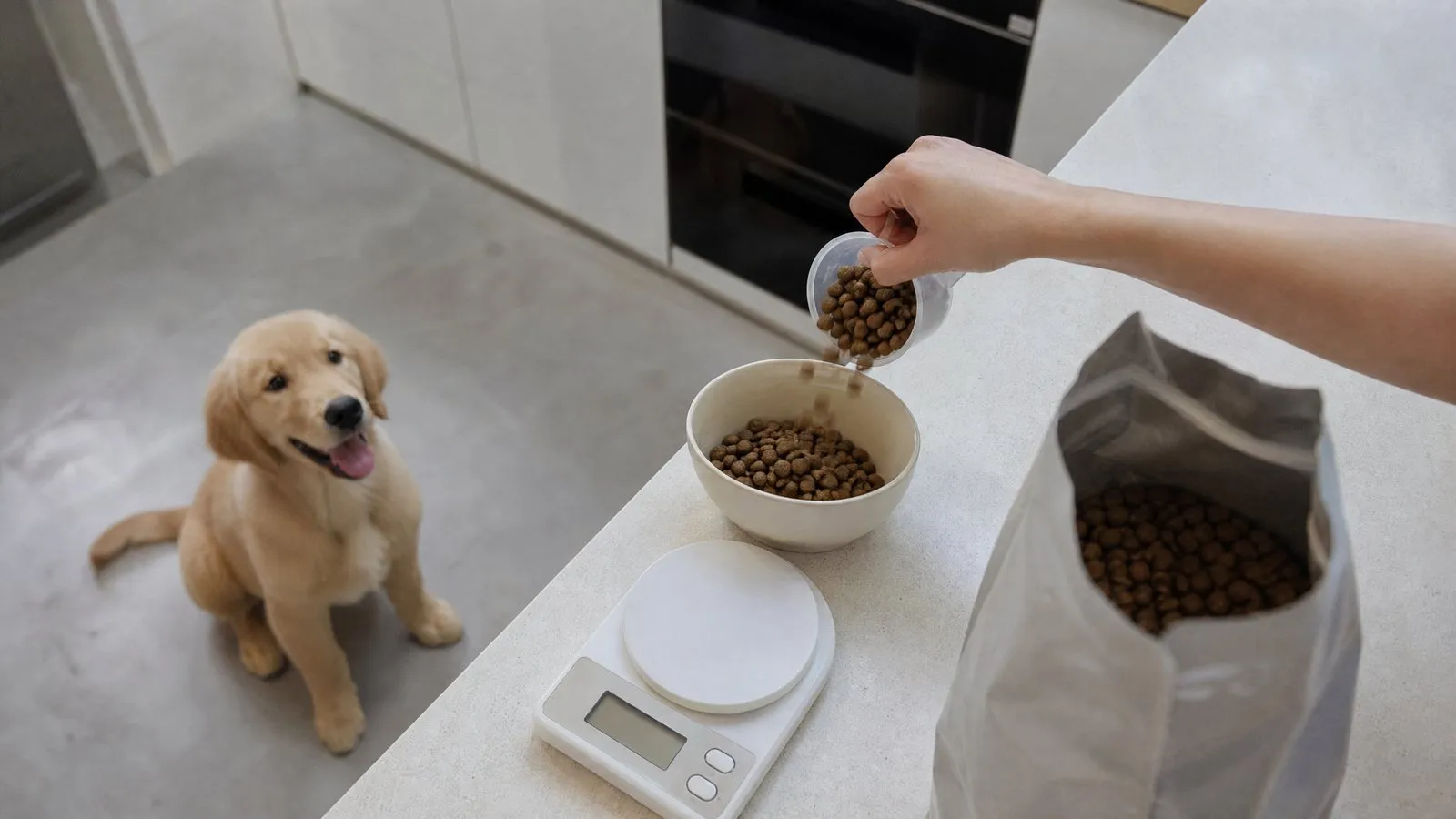
- Weigh food in grams when you can. A $10 kitchen scale is more accurate than any cup, and grams remove the density problem entirely. If the bag says 380 kcal per 100 g and your puppy needs 702 kcal, that’s about 185 g per day.
- Recheck the number every time you change food. Even within one brand, puppy, large-breed, and adult formulas have different calorie densities.
For help decoding the rest of the bag, see how to read a dog food label.
Why the bag’s feeding chart is only a starting point
Feeding charts on the bag are built around averages and tend to run generous. They’re a reasonable first guess, but they can’t account for the things that actually determine your individual puppy’s needs:
- Expected adult size. A Labrador puppy and a Cavalier puppy can weigh the same at 10 weeks and need very different amounts by six months.
- Activity level. A puppy that gets several play and training sessions a day burns more than one that mostly naps. (And they should nap a lot, see how much puppies should sleep.)
- Spay/neuter status. Calorie needs drop after the procedure.
- Treats. Training treats, chews, and food toppers all add up. Keep treats to no more than about 10% of daily calories and subtract them from the meal total.
- Metabolism. Some puppies simply run hot or cold compared to the average.
The chart gets you in the right ballpark. Your puppy’s body tells you whether you’re actually right.
Read your puppy’s body, not just the scale
The single most useful skill is body condition scoring (BCS), a 9-point scale used by veterinarians where 4 to 5 out of 9 is ideal. You can assess it at home in under a minute:
- Ribs: You should be able to feel the ribs easily with light pressure, like feeling the back of your hand, without pressing hard. If you have to dig, that’s too much weight. If they’re sharp and visible, too little.
- Waist (from above): Looking down, you should see a visible waist behind the ribs, an hourglass rather than a sausage.
- Tuck (from the side): The belly should tuck up toward the back legs, not hang level or sag.
Check this every week or two and adjust. A rough rule: if your puppy is drifting above ideal condition, cut daily food by about 10% and reassess in two weeks; if ribs and spine are becoming too prominent, add about 10%.
One important nuance for puppies: growing puppies look leaner than adults, and that’s healthy. Fast “chubby puppy” growth, especially in large and giant breeds, is linked to orthopedic problems. Lean growth is the goal, not maximum growth.
Weigh regularly, but expect a moving target
Puppies should gain steadily, not in huge jumps. Weigh weekly if you can (small puppies on a kitchen scale, larger ones by holding them on a bathroom scale and subtracting your own weight). Bring these numbers to vet visits. Because your puppy is gaining weight constantly, their calorie target rises for a while, then starts to fall as the growth multiplier drops from 3× to 2× and they approach adult size. Recalculate every two to four weeks.
Putting it together: a simple routine
- Weigh your puppy and convert to kilograms.
- Calculate RER: 70 × kg^0.75.
- Multiply by 3 (under 4 months) or 2 (4 months to adult size).
- Divide by the kcal-per-cup (or per-100 g) figure on your bag.
- Split across the day’s meals.
- Subtract treat calories.
- Check body condition every 1 to 2 weeks and adjust by about 10% at a time.
Do the math once, then let your eyes and hands fine-tune it. For the heavy lifting, the Puppy Food Calculator will run steps 2 through 5 for you.
A note on large and giant breeds
If your puppy will grow to roughly 25 kg (55 lb) or more as an adult, feeding gets a little more cautious. The AVMA and veterinary nutritionists emphasize that large-breed puppies need controlled growth and correct calcium levels to protect developing joints. Use a food labeled complete for growth of large-size dogs (check the AAFCO or equivalent nutritional adequacy statement), and err toward lean body condition. When in doubt, ask your vet to confirm your target and timeline, and see our guide on when to switch from puppy food to adult food.
When to call your vet
Contact your veterinarian promptly if your puppy:
- Refuses food for more than about 12 hours, or skips two meals in a row, especially in a puppy under four months (small puppies can drop their blood sugar dangerously fast).
- Is vomiting, has diarrhea, or seems lethargic alongside not eating.
- Is not gaining weight, or is losing weight.
- Is gaining too fast or looks consistently overweight despite careful feeding.
More general red flags are covered in warning signs your puppy needs a vet today. Your puppy’s regular checkups are also the right place to confirm their ideal weight and feeding plan, see your puppy’s first vet visit.
FAQ
How many cups should I feed my puppy per day?
There’s no single cup answer, because foods differ in calories per cup. Calculate your puppy’s daily calories (70 × kg^0.75, then × 3 under 4 months or × 2 after), then divide by the kcal-per-cup printed on your bag. A 5 kg three-month-old needs about 700 calories a day, which is roughly 2 cups of a 350-kcal/cup food but only about 1.6 cups of a 450-kcal/cup food.
Should I feed free-choice or measured meals?
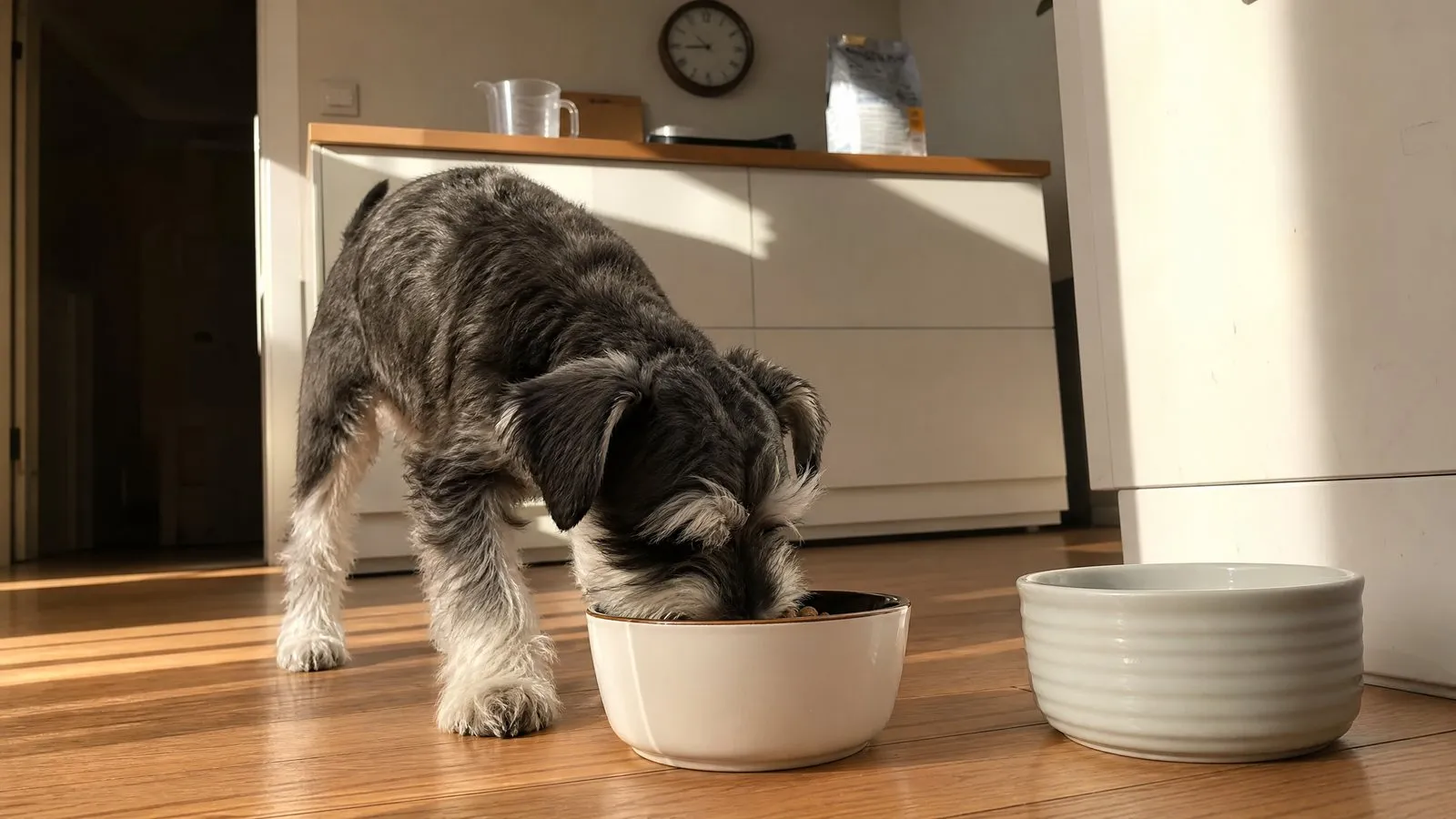
Feed measured meals at set times, not a bowl left out all day. Scheduled meals let you track appetite (a key early sign of illness), support house-training, and keep calories controlled. Most puppies do well on three meals a day until around four to six months, then two meals.
My puppy always acts hungry. Should I feed more?
Not on behavior alone. Many puppies act ravenous regardless of how much they’ve eaten. Trust body condition instead: if you can easily feel the ribs and see a waist, your puppy is at a healthy weight even if the begging is theatrical. If they’re thin by the body checks above, increase food by about 10% and reassess in two weeks.
How often should I recalculate the amount?
Every two to four weeks while your puppy is growing. Their weight changes constantly, and the growth multiplier steps down from 3× to 2× at around four months, so last month’s number will usually be off. Recheck sooner if you change foods.
Do treats count toward daily calories?
Yes. Treats, chews, dental sticks, and food used in training all add calories. Keep them to about 10% of the daily total and subtract that from meal portions, otherwise it’s easy to overfeed a well-measured dinner without realizing it.
A note on health information: Health and nutrition guides are written against published guidance from the AAHA, WSAVA and AVMA. They are general information, not a substitute for advice from your own veterinarian. If your dog seems unwell, call your vet.