6 Commands to Teach Your Puppy First (and Exactly How)
Teach your puppy name recognition, sit, down, come, leave it, and drop it with simple steps, 3-5 minute routines, and common mistakes to avoid.
Start with these six: name recognition, sit, down, come, leave it, and drop it. They cover the basics of safety, manners, and communication, and you can begin all of them the day your puppy comes home. Keep each session to 3-5 minutes, a few times a day, and use small, soft treats your puppy can eat fast.
Puppies learn best in tiny bursts. A sleepy or overstimulated puppy won’t absorb much, so aim for short sessions after a nap and before a meal, when your puppy is awake, calm, and a little hungry. End every session while your puppy is still interested, not when you’re both frustrated.
Before you start: the basics that make everything work
A few ground rules save you weeks of confusion.
- Use a marker. Say a short word like “yes” the instant your puppy does the right thing, then deliver a treat within a second or two. The marker tells your puppy exactly what earned the reward. A clicker works the same way if you prefer one.
- Pay well at first. Use pea-sized, high-value treats (soft and smelly beats dry and bland). Reward every correct response early on, then thin out the treats once the behavior is reliable.
- Train in a boring room first. A quiet kitchen or living room with no other dogs, people, or toys is where new skills stick. Add distractions only after your puppy is succeeding easily.
- One cue, said once. Don’t repeat “sit, sit, sit.” Say it once, wait, and help if needed. Repeating teaches your puppy that the word is optional.
- Keep it positive. Reward-based training is what the American Veterinary Medical Association and most veterinary behavior groups recommend. Avoid punishment-based methods, which can increase fear and aggression.
If your home still feels chaotic, it’s worth sorting the setup first. Our new puppy checklist and guide to puppy-proofing your home will clear the ground so training sessions aren’t constant interruptions.
A simple weekly plan
You don’t need to teach all six at once. A realistic order looks like this:
| Days | Focus | Add in |
|---|---|---|
| 1-3 | Name recognition | Start “sit” |
| 4-7 | Sit + name | Start “come” indoors |
| 8-12 | Down | Keep practicing come |
| 13-18 | Leave it | Start “drop it” |
| 19+ | Drop it | Proof all six with mild distractions |
Move at your puppy’s pace. Some pick up sit in a day; others need a week. That’s normal.
1. Name recognition
Goal: your puppy looks at you the instant they hear their name.
Your puppy’s name should always predict something good, never a scolding. Save it for getting attention, and use a different word (like “no” or “off”) for corrections.
Steps:
- Stand or sit near your puppy in a quiet room.
- Say their name once in a bright, friendly tone.
- The moment they turn toward you or make eye contact, mark with “yes” and give a treat.
- If they ignore you, make a soft kissy noise to get the look, then mark and reward. Don’t repeat the name.
- Repeat 8-10 times, then stop.
Practice routine (3-4 minutes): Scatter 10 tiny treats in your pocket. Say the name, reward the look, take a short pause, repeat. Do this two or three times a day in different rooms.
Common mistakes:
- Using the name for everything (coming, stopping, scolding) so it loses meaning.
- Repeating the name over and over until your puppy learns to tune it out.
- Only practicing at mealtime, so the name only “works” near food.
2. Sit
Goal: your puppy puts their bottom on the floor on cue.
Sit is the easiest win and a great default for calm behavior at doors, before meals, and when greeting people.
Steps:
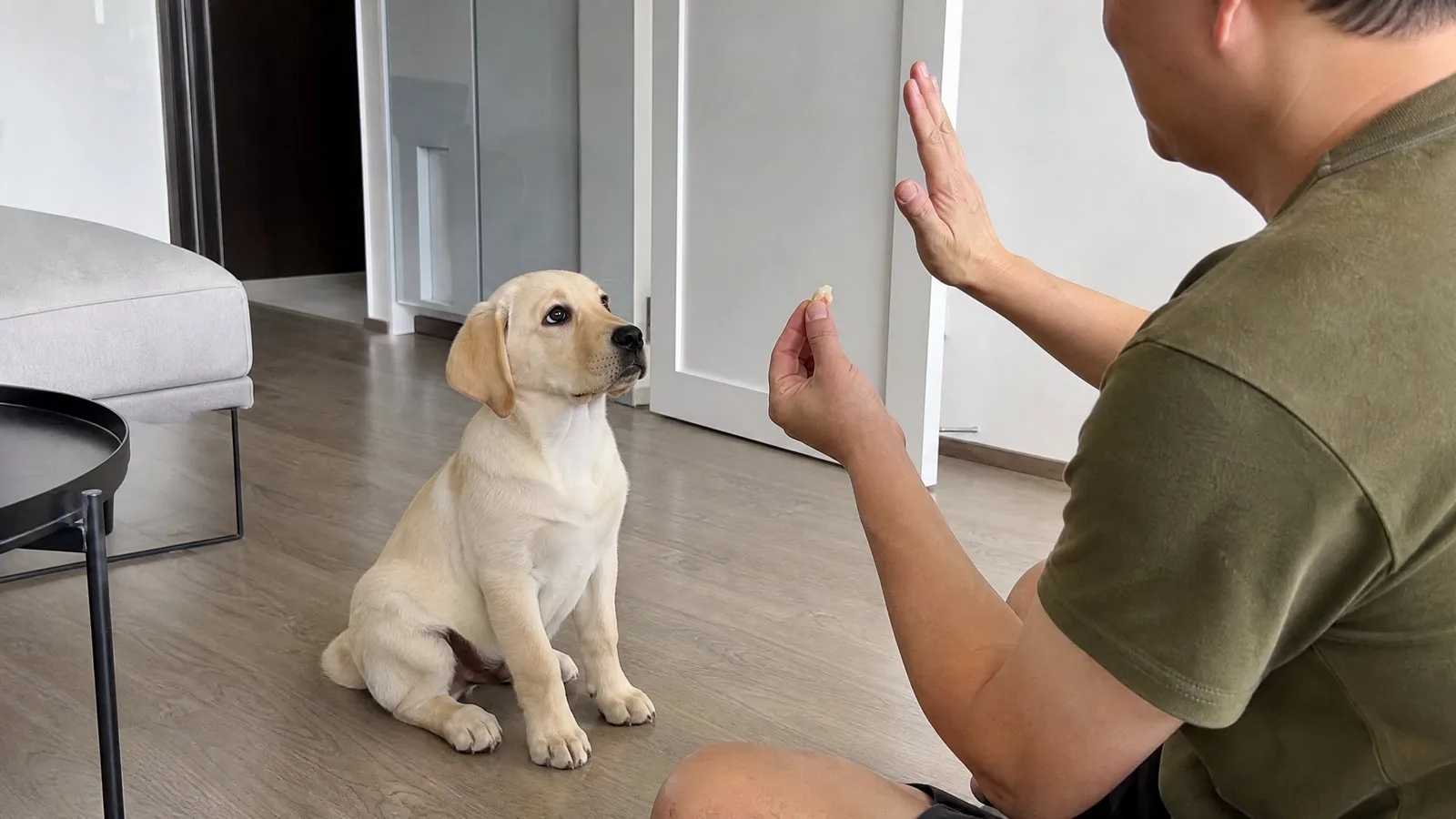
- Hold a treat just above your puppy’s nose.
- Slowly move it back over their head. As the nose follows up, the bottom usually drops down.
- The instant the bottom touches the floor, mark “yes” and give the treat.
- Repeat 5-6 times using the food lure.
- Now do the same hand motion with no treat in your hand, then reward from the other hand. This turns the motion into a hand signal.
- Once that’s reliable, add the word “sit” right before the hand signal.
Practice routine (3-5 minutes): Ask for 5-8 sits with short breaks. Mix in a few “free” moments so your puppy isn’t just repeating on autopilot. Practice before you put the food bowl down and before opening the door for a walk.
Common mistakes:
- Holding the treat too high, so the puppy jumps instead of sitting. Keep it close to the nose.
- Pushing the puppy’s rear down with your hand, which many dogs resist. Let the lure do the work.
- Adding the word “sit” before the puppy actually understands the motion.
3. Down
Goal: your puppy lies down with elbows and belly toward the floor.
Down is a calming position and useful for settling at cafes, the vet, or during dinner. It often comes right after sit.
Steps:
- Start with your puppy in a sit.
- Hold a treat at their nose, then move it straight down to the floor between their front paws.
- Slowly drag it a little along the floor toward you. Most puppies follow it down into a lie.
- The moment the elbows hit the floor, mark “yes” and reward.
- If the rear pops up instead, go slower and reward small steps, like lowering the head or one elbow dipping.
- Once reliable with the lure, fade the treat from your hand, then add the word “down.”
Practice routine (3-5 minutes): Ask for a few sit-to-down reps. Then try rewarding your puppy for staying down for 2 seconds, then 3, then 5, building duration gradually.
Common mistakes:
- Saying “down” when you mean “get off the sofa.” Pick one meaning and stick to it.
- Luring too fast, so the puppy stands and chases the treat.
- Training on a slippery floor. A rug or carpet gives better grip and more confidence.
4. Come (recall)
Goal: your puppy runs to you fast and happily when called.
A solid recall is a safety skill, so make it the most rewarding thing your puppy ever does. Always pay for coming, and never call your puppy to do something they dislike.
Steps:
- Start indoors, a few feet away.
- Say your puppy’s name, then “come” in a happy, excited voice.
- The moment they move toward you, cheer them on. When they reach you, mark “yes” and give 2-3 treats in a row, plus praise.
- Gently take their collar before giving the last treat, so being grabbed predicts good things.
- Gradually increase distance and move to new rooms, then a hallway, then a fenced yard.
Practice routine (3-5 minutes): Play “ping-pong recall” with a family member. Take turns calling the puppy back and forth across the room, rewarding every arrival. Keep it fun and fast.
Common mistakes:
- Calling “come” to do something unpleasant, like nail trims or ending playtime. This teaches your puppy to avoid the word.
- Repeating “come, come, come” when the puppy ignores you. If they don’t respond, go closer and make yourself more exciting.
- Taking it off-leash outdoors too soon. Outdoors, use a long training line until recall is rock solid. This also makes leash training smoother.
5. Leave it
Goal: your puppy turns away from something on cue, before they grab it.
“Leave it” protects your puppy from dropped food, trash, and hazards on walks. It’s about choosing to leave a thing alone.
Steps:
- Put a treat in your closed fist. Let your puppy sniff and lick.
- Say nothing and wait. The instant they pull back or stop pushing, mark “yes” and reward from your other hand, not the fist.
- Repeat until they back off quickly. Now add the words “leave it” as you present the fist.
- Progress to a treat on the floor under your flat hand, ready to cover it. Reward backing off.
- Finally, place a treat on the floor uncovered. Say “leave it.” Cover it with your hand if needed. Reward from your other hand every time they resist.
Key rule: your puppy never gets the thing they left. The reward always comes from you, and it’s usually better than the item they ignored.
Practice routine (3-4 minutes): Do 6-8 reps, gradually making the item more tempting. Later, practice with a toy, then while walking past a dropped treat.
Common mistakes:
- Letting the puppy eat the “leave it” item. That rewards grabbing, not leaving.
- Moving to the floor stage before the closed-fist stage is solid.
- Using an angry voice. “Leave it” should be a calm cue, not a scold.
6. Drop it
Goal: your puppy opens their mouth and releases whatever they’re holding.
“Drop it” is different from “leave it”: leave it means don’t touch, drop it means let go of what you already have. It’s essential for both safety and your socks. Teach it as a happy trade, not a wrestling match.
Steps:
- Give your puppy a low-value toy they’ll hold but won’t guard.
- Hold a treat near their nose. Most puppies open their mouth to take it and drop the toy.
- The moment the toy leaves their mouth, say “drop it,” mark “yes,” and give the treat.
- Pick up the toy, then give it right back so your puppy learns that dropping doesn’t mean losing the fun.
- Repeat, then start saying “drop it” just before you offer the treat.
- Over time, trade for an equal or better toy instead of always using food.
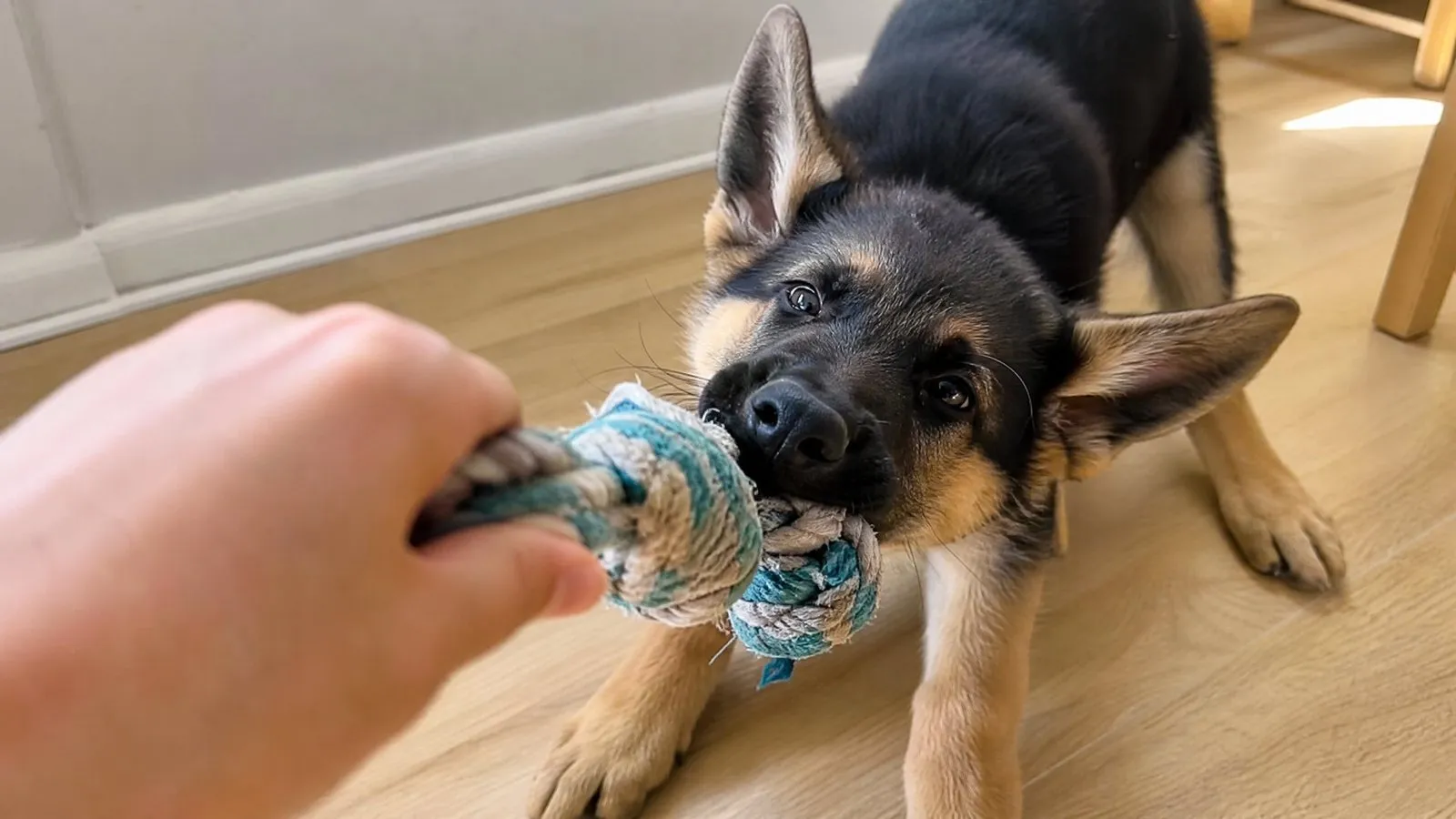
Practice routine (3-4 minutes): Play a short tug or fetch game and work “drop it” into it naturally. Drop, reward, resume the game. Keep the whole thing upbeat.
Common mistakes:
- Chasing your puppy to pry the item out. This turns into a thrilling game of keep-away and can cause resource guarding.
- Only using “drop it” to take things away, so the puppy learns to run and hide with their prize. Always trade or give it back when it’s safe.
- If your puppy stiffens, freezes, or growls over objects, stop and contact a certified trainer or veterinary behaviorist. Guarding is common but best addressed early with professional guidance.
Keep it short, keep it fun
Three to five minutes, a few times a day, beats one long session every time. End before your puppy loses interest, and finish on a win they can do easily. Over a few weeks, these six cues become second nature.
Training also tires puppies out mentally, which helps with rest. If your puppy struggles to settle, our guide on how much a puppy should sleep explains what’s normal by age. And remember that biting, chewing, and testing limits are all part of this stage. Our guide on how to stop puppy biting pairs well with early training.
FAQ
How old does my puppy need to be to start training?
You can start the day you bring them home, usually around 8 weeks. Young puppies learn quickly; just keep sessions very short and use gentle, reward-based methods. There’s no need to wait.
My puppy only listens when I have treats. What now?
That’s normal early on. Once a cue is reliable, start rewarding every other correct response, then every third, mixing in praise and play. Keep treats unpredictable so your puppy stays motivated without expecting food every time.
How many commands should I work on in one day?
Pick one or two to focus on per session, and no more than a handful of short sessions a day. Spreading practice across the day in 3-5 minute bursts works far better than one long drill.
What if my puppy just won’t focus?
Check the basics first: is your puppy tired, overstimulated, or too full? Move somewhere quieter, use better treats, and shorten the session. If focus is consistently impossible even in a calm room, talk to your vet to rule out any underlying issue.
Should I take a puppy class too?
Yes, if you can. A well-run puppy class adds socialization and real-world distractions that are hard to recreate at home. Look for classes that use reward-based methods and group puppies by age or size.