Leash Training: How to Teach Your Puppy to Walk Without Pulling
Teach your puppy to walk without pulling using simple gear, indoor practice, the be-a-tree and direction-change methods, and short daily sessions.
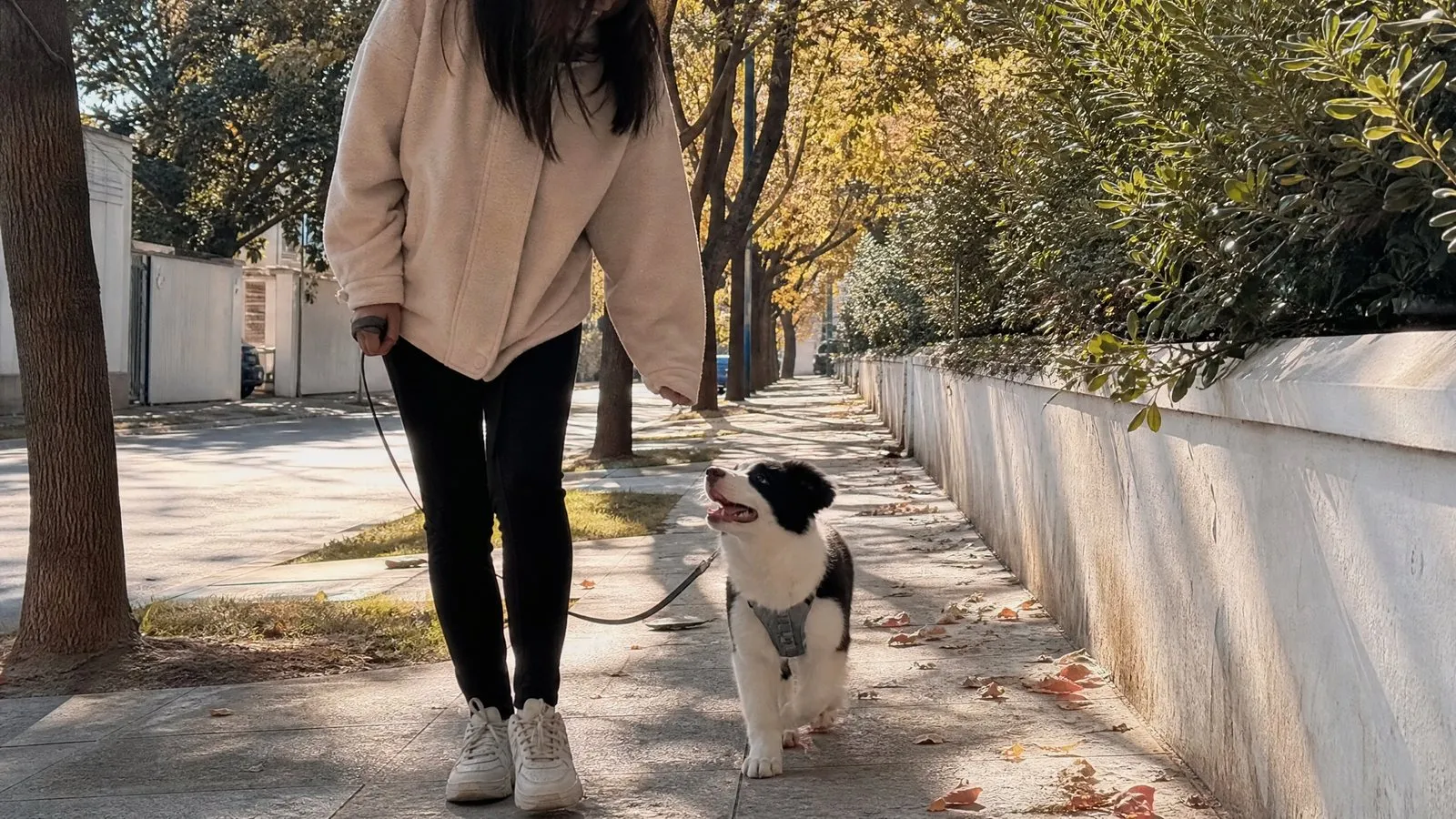
Loose-leash walking comes from short, calm practice sessions where you reward your puppy for staying near you and stop moving whenever the leash goes tight. Start indoors, keep sessions to 5 minutes, and use high-value treats delivered right at your leg. Most puppies take weeks to get reliable, and progress is rarely a straight line. Here’s exactly how to do it.
Start with the right gear
Good equipment makes training easier and keeps your puppy comfortable. You don’t need anything fancy.
- Flat collar or harness. For most puppies, a well-fitted harness is kinder on the neck and gives you more control without choking. A front-clip (chest) ring can reduce pulling by turning your puppy gently toward you. If you’re unsure which to use, our guide on harness vs. collar for puppies walks through the trade-offs.
- A fixed-length leash, about 4 to 6 feet (1.2 to 1.8 m). This is your main training tool. It gives enough room to move but keeps your puppy close.
- Skip the retractable leash for training. It teaches your puppy that pulling extends the lead, which is the opposite of what you want. Use it later for sniff-walks in open spaces if at all.
- A treat pouch and small, soft treats. You’ll deliver a lot of rewards, so cut them pea-sized. A pouch clipped to your waist keeps both hands free.
What to avoid
Skip choke chains, prong collars, and slip leads for a young puppy learning the basics. The American Veterinary Medical Association and major veterinary behavior groups favor reward-based methods, which are effective and carry less risk of fear or injury. Tools that work by causing discomfort can backfire, especially with a nervous puppy.
A harness should fit snugly but let you slide two fingers under any strap. Check the fit often, because puppies grow fast.
Step 1: Get your puppy comfortable wearing the gear indoors
Before you ever reach the sidewalk, let your puppy decide the collar and harness are no big deal.
- Introduce the harness with treats. Hold it out, let your puppy sniff it, and feed a treat. Drape it over their back, treat again. Don’t rush to buckle it.
- Put it on for short bursts. Fasten it, feed a few treats, then take it off after a minute or two. Build up over a few days until your puppy wears it happily during play and meals.
- Add the leash indoors. Clip it on and let your puppy drag it around a puppy-proofed room while you supervise, so it feels normal and not restricting. (If you haven’t already, our room-by-room puppy-proofing guide helps you clear hazards first.)
- Practice “follow me” in the hallway. Pick up the leash, say your puppy’s name, and reward them for taking a step toward you. This is leash walking in miniature, with no distractions.
Spend two or three days here. A puppy that scratches at a new harness or freezes on the leash isn’t being stubborn, they just need more positive associations first.
Step 2: Nail your reward placement
Where you deliver the treat matters more than almost anything else. You’re teaching your puppy that the best place in the world is right beside your leg.
- Decide on a side. Most people walk a dog on the left, but either is fine. Pick one and stay consistent so your puppy learns a default position.
- Reward at the seam of your pants. Deliver each treat down low, right next to your leg, not out in front of your body. If you reward in front, your puppy learns to drift forward.
- Mark the moment. Say a quick “yes” or use a clicker the instant your puppy is in the right spot, then feed. The word tells them exactly what earned the treat.
- Feed often at first. In early sessions you might reward every few steps. That’s normal. You’ll stretch the gaps as your puppy improves.
Step 3: The “be a tree” method
This is the simplest way to teach that pulling never works. The rule: when the leash goes tight, all forward motion stops.
- Start walking. The moment your puppy pulls and the leash tightens, stop dead and stand still like a tree. Don’t yank the leash or scold.
- Wait. Your puppy will eventually ease the tension, look back, or step toward you.
- The instant the leash loosens, mark (“yes”) and reward at your leg, then start walking again.
- Repeat every single time the leash tightens.
Your puppy quickly learns that pulling stops the fun and that a loose leash makes the walk continue. The first few walks may be slow and stop-start. That’s the method working, not failing.
Consistency is the whole game. If pulling sometimes gets your puppy to the exciting lamp post, you’ve accidentally taught them that pulling pays off occasionally, which is powerful. Everyone who walks the puppy needs to follow the same rule.
Step 4: The direction-change method
Use this alongside “be a tree,” especially for puppies who are too excited to notice they’ve stopped moving.
- When your puppy forges ahead, say something upbeat like “this way.”
- Turn and walk calmly in the opposite direction. Your puppy now has to catch up to you.
- As they reach your side, mark and reward, then carry on.
This keeps your puppy paying attention to where you are instead of pulling toward whatever caught their eye. Make the turns smooth, not a sudden jerk on the leash. You’re guiding, not correcting.
Many owners combine both methods naturally: stop when the leash tightens, change direction when your puppy is fixated, and reward generously every time they choose to walk near you.
Step 5: Keep sessions short
Puppies have tiny attention spans, and leash training is mentally tiring. Short and frequent beats long and frustrating.
| Age | Session length | Sessions per day | Where |
|---|---|---|---|
| 8–10 weeks | 2–5 minutes | 2–3 | Indoors / yard |
| 10–16 weeks | 5–10 minutes | 2 | Quiet outdoor areas |
| 4–6 months | 10–15 minutes | 1–2 | Gradually busier areas |
| 6+ months | 15–20 minutes | 1–2 | Varied environments |
End each session before your puppy gets tired or distracted, ideally on a small win. If a session falls apart, it’s usually a sign you went too long, too far, or too close to distractions.
A quick note on physical limits: very young puppies shouldn’t do long or high-impact exercise while their joints develop. These sessions are about training, not distance. A tired puppy also learns poorly, so make sure yours is getting enough rest; our guide on how much a puppy should sleep explains the surprising amount they need.
A note on vaccinations and where you walk
Until your puppy has had the vaccines your vet recommends, avoid areas heavily used by unknown dogs. You can still train in your home, yard, or on clean low-traffic surfaces, and carry your puppy to new places for early socialization. Check timing with your vet and see our puppy vaccination schedule for what’s typical.
Working up to real walks
Once your puppy walks nicely in quiet settings, add difficulty one step at a time. Think of distractions on a dial, not a switch.
- Change one thing at a time. A new street, then more people, then another dog at a distance. If your puppy pulls hard, you’ve likely jumped too far, too fast.
- Allow sniff breaks. Sniffing is how dogs read the world, and it’s genuinely enriching. Use a cue like “go sniff” to release your puppy to a spot, then call them back to walking. This also makes loose-leash walking the “default” and sniffing the reward.
- Keep rewarding good position, even once your puppy is doing well. You can thin out treats gradually, but don’t drop them entirely too soon.
- Watch for the teen phase. Around 6 to 12 months many dogs seem to “forget” their training. This is normal adolescence. Go back to easier settings and higher reward rates for a while.
If your puppy lunges, barks, or freezes at other dogs or people rather than just pulling from excitement, that can be fear or overstimulation rather than a walking problem. A certified, reward-based trainer or your vet can help you tell the difference and make a plan.
A realistic timeline
Be honest with yourself about pace. Loose-leash walking is one of the harder things you’ll teach, because the outside world is more exciting than you are.
- Days 1–3: Comfortable in harness and leash indoors.
- Week 1–2: Follows you around the house and yard on a loose leash for short stretches.
- Weeks 2–6: Walks nicely in quiet outdoor areas with frequent rewards; still pulls sometimes.
- Months 2–4: Handles mild distractions; you reward less often.
- 6–12 months and beyond: Reliable in most settings, with refresher work through adolescence.
Some puppies click faster, some need longer, and breed, energy level, and your own consistency all matter. The dogs who get there are simply the ones whose owners kept sessions short, rewards generous, and the “loose leash means we move” rule unbroken.
Leash training pairs well with the other foundations you’re building. If you’re just getting started, our first commands to teach a puppy covers “name” and “come,” both of which make walks easier.
FAQ
My puppy just sits down and won’t move. What do I do?
Freezing is common and usually means your puppy is overwhelmed, tired, or unsure. Don’t drag them. Crouch down a step or two ahead, sound cheerful, and lure them to you with a treat, then reward. Shorten the session and practice somewhere quieter. If freezing happens often, build more positive leash time indoors before heading out.
Should I use a harness or a collar for leash training?
For most puppies a harness is the safer choice, because it keeps pressure off the neck and a front clip can gently reduce pulling. A flat collar is fine for calm walkers and for holding ID tags. Avoid choke, prong, or slip tools for a young puppy learning the basics. See our harness vs. collar guide for details.
How long until my puppy stops pulling completely?
Expect weeks to months, not days. Many puppies walk well in quiet areas within a few weeks but still need practice around strong distractions well into adolescence. Consistency from everyone who walks the dog is the biggest factor in how fast it sticks.
Can I train loose-leash walking before my puppy is fully vaccinated?
Yes. Do most of your early work indoors and in your own yard, and avoid areas used by unknown dogs until your vet gives the go-ahead. You can still carry your puppy out to see the world for socialization. Confirm timing with your vet.
Is it okay to let my puppy sniff on walks?
Absolutely, and you should. Sniffing is mentally enriching and tiring in a good way. Put it on cue, such as “go sniff,” so it becomes a reward you give for walking nicely, rather than something your puppy drags you toward.