Crate Training a Puppy: A 7-Day Step-by-Step Plan
A calm 7-day crate training plan for puppies, with session lengths, positive-association steps, how long puppies can stay crated, and whining fixes.
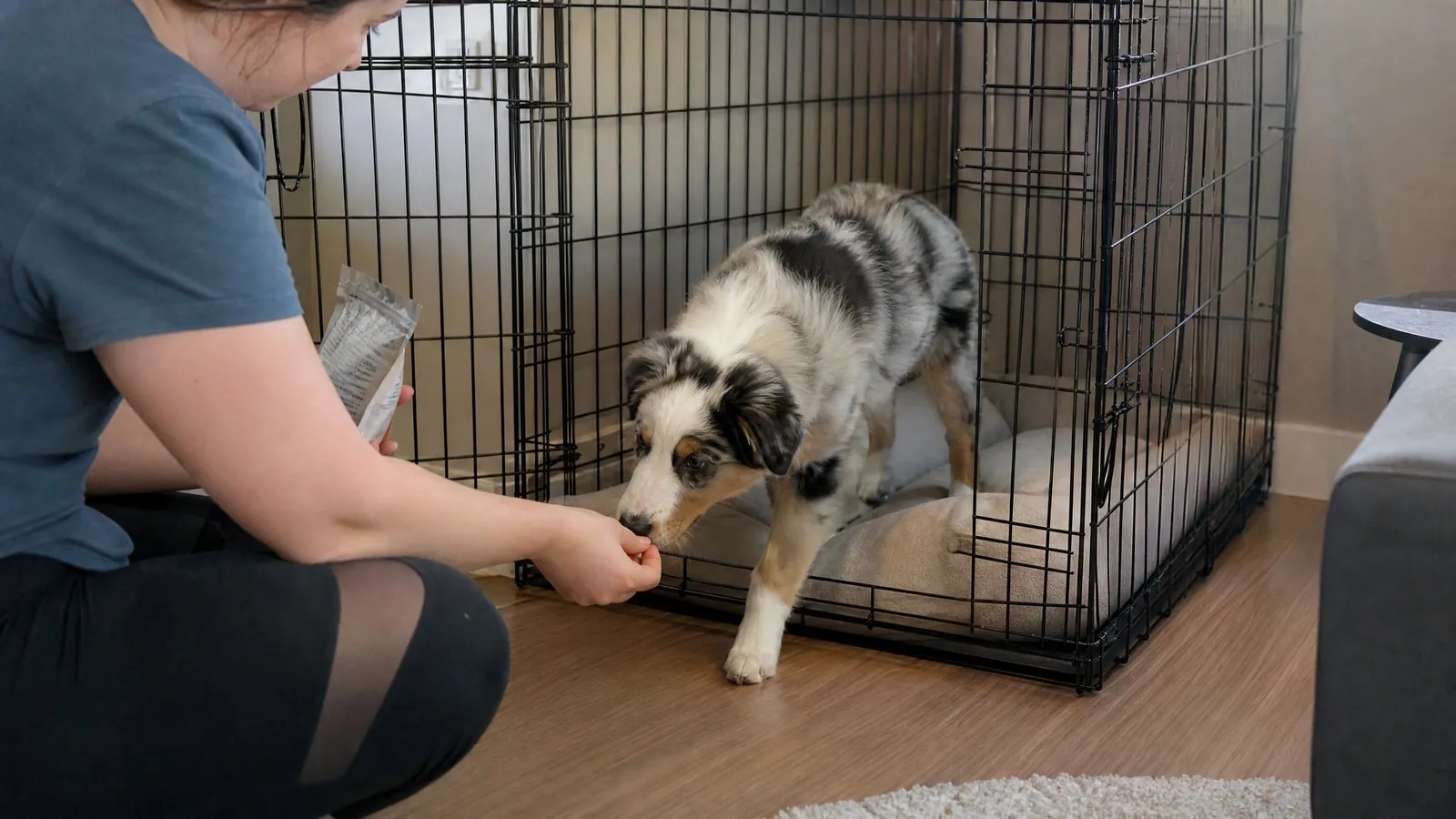
Crate training works best as a slow, positive process spread over about a week, not a single stressful night. The goal is simple: your puppy chooses to go into the crate because good things happen there. Below is a day-by-day plan with exact session lengths, how to handle whining, and how long a puppy can actually hold it by age.
If you haven’t picked a crate yet, size it so your puppy can stand, turn around, and lie down fully, but no bigger. Too much space lets them potty in one corner and sleep in another. Our guide on how to choose the right dog crate covers sizing and divider panels for growing puppies.
Before you start
Set the crate up in a quiet corner of a room where your family spends time, not an isolated laundry room or garage. Puppies are social and settle faster when they can sense you nearby, especially in the first weeks.
Gather these before Day 1:
- A handful of pea-sized, soft treats your puppy loves
- A safe chew or a food-stuffable toy (frozen works well for teething pups)
- A washable crate mat or towel
- A short daily window, 10 to 15 minutes, two or three times a day
A few ground rules that make or break the whole process:
- Never use the crate as punishment. It must stay a safe, positive place.
- Don’t force your puppy in. Lure and reward instead.
- Keep early sessions short and end on a calm note, not a frantic one.
- Match crate time to bladder limits (table below). Crate training and potty training move together.
If you’re still setting up your home, pair this with our new puppy checklist and room-by-room puppy-proofing guide.
How long can a puppy stay in a crate?
A good rule of thumb for daytime bladder control is your puppy’s age in months plus one, in hours, up to a maximum of about 4 hours during the day. Nighttime is different: puppies often sleep longer stretches because their body slows down, though very young pups will still need one or two overnight potty breaks.
| Puppy age | Max daytime crate stretch (awake limit) | Realistic overnight stretch |
|---|---|---|
| 8–10 weeks | 30–60 minutes | 2–4 hours, then a potty break |
| 10–12 weeks | 1–2 hours | 3–5 hours |
| 3–4 months | 2–3 hours | 5–6 hours |
| 4–6 months | 3–4 hours | 6–7 hours |
| 6+ months | Up to 4 hours | 7–8 hours |
These are ceilings, not targets. No dog of any age should be crated all day. If you work long hours, arrange a midday walk, a dog walker, or a secure pen so your puppy gets out, moves, and eliminates on schedule.
The 7-day crate training plan
Each day builds on the last. If your puppy struggles on any day, repeat it before moving on. Some pups breeze through in four days; others need ten. Both are normal.
Day 1: Make the crate exist, with no pressure
Leave the crate door open all day. Toss a few treats inside throughout the day and let your puppy discover them on their own. Do not close the door or say anything; just let the crate become a place where food appears.
- Sessions: 3–4 casual treat tosses across the day
- Door: stays open
- Goal: puppy walks in and out freely to grab treats
Feed one meal with the bowl placed just inside the entrance, or near it if your puppy hesitates.
Day 2: Meals inside, door still open
Move the food bowl fully inside the crate for every meal. Sit nearby and let your puppy eat with their whole body in the crate. Keep the door open the entire time.
- Sessions: every mealtime plus 2–3 treat tosses
- Door: stays open
- Goal: puppy eats calmly inside, lingers a little afterward
Start adding a cue word like “crate” or “bed” in a cheerful voice right as your puppy steps in. Reward the moment all four paws are inside.
Day 3: Close the door for seconds
While your puppy is eating or chewing happily inside, gently close the door for 5 to 10 seconds, then open it before they finish. Build up to keeping it shut for the length of a meal.
- Sessions: 3 short sessions, 1–2 minutes each
- Door: closed briefly, then opened while puppy is still calm
- Goal: door closing predicts good things, not isolation
Stay right beside the crate. If your puppy stays relaxed, feed a few treats through the bars. Let them out quietly when they’re calm, never mid-whine.
Day 4: Build duration while you stay close
Give a stuffed chew, close the door, and sit next to the crate reading your phone for 2 to 5 minutes. You want your puppy to practice settling with the door shut while you’re present.
- Sessions: 2–3 sessions, 3–5 minutes each
- Door: closed
- Goal: puppy settles or chews instead of scratching at the door
End each session before your puppy gets restless. Open the door during a quiet moment and keep your reaction low-key so leaving the crate isn’t more exciting than being in it.
Day 5: Add short absences
Now close the door, give a chew, and step a few feet away. Leave the room for 30 seconds, come back calmly, and sit down. Gradually extend to 2 or 3 minutes out of sight.
- Sessions: 3 sessions, building from 30 seconds to 3 minutes away
- Door: closed
- Goal: puppy stays calm when you briefly disappear
Vary your timing so leaving the room doesn’t always mean the same thing. This early practice also lays groundwork against separation anxiety.
Day 6: Daytime naps in the crate
Puppies sleep a lot, around 18 to 20 hours a day at this age, so use natural sleepiness to your advantage. After play and a potty trip, settle your puppy in the crate for a nap with the door closed.
- Sessions: 1–2 naps, 30–90 minutes depending on age
- Door: closed
- Goal: crate becomes the default nap spot
See how much a puppy should sleep to match nap timing to your pup’s age. A tired puppy settles far more easily than an overtired, wired one.
Day 7: Put it together with a real routine
Combine everything into a daily rhythm: potty break, play or training, calm settle in the crate, repeat. Practice one slightly longer absence (10 to 20 minutes) while you do something in another part of the house.
- Sessions: 2–3 real-life crate periods matched to the age limits above
- Door: closed
- Goal: your puppy goes in on cue and settles without fuss
By now the crate should feel like a bedroom, not a cage. Keep reinforcing it for the next few weeks; one good week builds the habit, consistency cements it.
Overnights: what to expect
The first few nights are usually the hardest, and that’s normal. Place the crate in or near your bedroom at first so your puppy can hear and smell you. Young puppies physically cannot hold their bladder all night, so set an alarm for one potty break for pups under about 12 weeks.
Keep night potty trips boring: carry or walk your puppy out, let them go, praise quietly, and return to the crate with no play. For a deeper breakdown of overnight crying and what helps, see why your puppy cries at night. Crate training and potty training reinforce each other, so run them together.
What to do about whining
First, figure out why. Whining in the crate usually means one of three things:
- A genuine need — your puppy has to potty. Puppies under 12 weeks often do, especially overnight.
- Protest — they’d rather be out with you.
- Too much, too soon — the session is longer than they’re ready for.
How to respond:
- If a potty break is plausibly due, take them out calmly, let them go, and return to the crate with minimal fuss. Don’t make it a party.
- If you’re sure they don’t need to potty, wait for a pause in the whining, even a two-second gap, then quietly reward or let them out during the calm moment. This teaches that quiet, not noise, opens the door.
- Never let a puppy out mid-scream repeatedly. It teaches that louder and longer works. But also don’t ignore escalating distress for long stretches, which can make fear worse.
If your puppy panics hard every time the door closes, or escalates to drooling, frantic escape attempts, or hurting themselves, back up to an easier step and shorten sessions. Persistent, intense distress can signal separation anxiety and is worth a conversation with your vet or a qualified behaviorist.
Mistakes to avoid
- Using the crate as punishment. Even once undermines the positive association you’re building.
- Crating too long. Exceeding the age limits in the table leads to accidents and stress, and slows potty training.
- Going too fast. Skipping to closed-door absences before your puppy is comfortable eating inside usually backfires.
- Big emotional hellos and goodbyes. Keep arrivals and departures calm so the crate stays low-drama.
- A crate that’s too big. Extra space invites potty accidents. Use a divider and expand it as your puppy grows.
- Leaving unsafe items inside. Skip collars with dangling tags, and choose chews appropriate for unsupervised time. See safe chews for teething puppies.
When to get help
Most puppies adapt within one to two weeks. Reach out to your veterinarian or a credentialed trainer or behaviorist if your puppy shows intense, lasting panic in the crate, injures themselves trying to escape, won’t settle at all after two or more weeks of consistent, gradual work, or has frequent accidents despite an age-appropriate schedule. Professional organizations such as the American Veterinary Medical Association and the American Animal Hospital Association emphasize reward-based training and recommend ruling out medical causes when house-training or settling problems persist.
FAQ
Should I cover the crate with a blanket?
Many puppies settle better in a dimmer, den-like space, so a breathable cover over part of the crate can help. Make sure air flows freely and your puppy can’t pull the fabric inside to chew. If your pup seems more anxious covered, leave it open.
Can I crate my puppy while I’m at work all day?
No. A puppy should never be crated for a full workday. Match crate time to the age-based limits above and arrange a midday break with a walker, neighbor, or a safe puppy-proofed pen so your puppy can move and potty.
My puppy had an accident in the crate. What went wrong?
Usually the crate is too big, the stretch was too long for their age, or they signaled and weren’t let out in time. Shorten the interval, use a divider to reduce space, and recheck the age limits in the table. Clean with an enzymatic cleaner to remove the scent.
Is it too late to crate train an older puppy or adult dog?
No. The same 7-day plan works at any age; older dogs often progress faster. Go at your dog’s pace and repeat any day they find difficult.
How do I eventually stop using the crate?
Once your dog reliably settles and is fully house-trained and trustworthy with household items, usually well into adulthood, you can leave the door open or transition to a dog bed. Many dogs keep using the crate by choice as their preferred resting spot.