How to Choose the Right Dog Crate: Size, Type, and Divider Tips
Learn how to measure your dog for the right crate size, compare wire, plastic, soft, and furniture crates, and use a divider as your puppy grows.
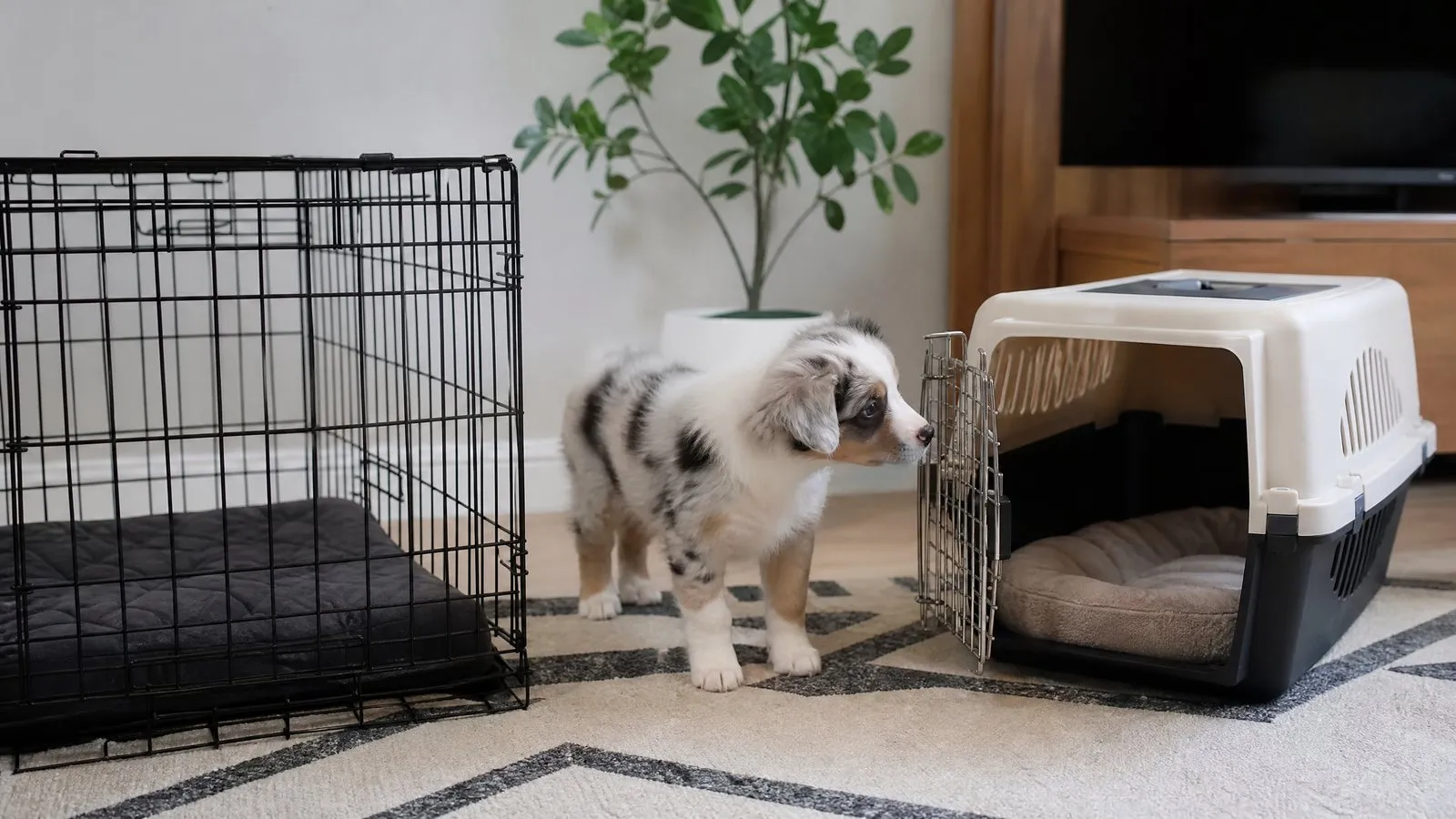
The right crate is just big enough for your dog to stand up, turn around, and lie down fully stretched out, and no bigger while you’re house-training. Measure your dog first, buy for their adult size if you can, and use a divider to shrink the space while they’re small. For most families, a wire crate with a divider panel is the easiest, most flexible choice.
Here’s how to get the size, type, and setup right the first time.
Start by measuring your dog
You need two numbers: length and height. A soft tape measure works best, but a piece of string you then lay against a ruler is fine.
- Length: Measure from the tip of the nose to the base of the tail (where the tail meets the body, not the tip of the tail). Add 2 to 4 inches (5 to 10 cm).
- Height: Measure from the floor to the top of the head while your dog is sitting or standing in a normal posture. If your dog has upright ears, measure to the tip of the ears. Add 2 to 4 inches (5 to 10 cm).
Those two totals are your minimum interior crate dimensions. The crate should let your dog stand without ducking, turn around comfortably, and lie flat on their side.
What size for a puppy who’s still growing?
Buy for the adult size and use a divider (more on that below). If you buy a tiny crate now, you’ll be buying another one in two months.
If you don’t know your puppy’s adult size, estimate from the breed or, for a mixed-breed rescue, ask your vet or rescue for a projected adult weight. These crate sizes are a rough guide by adult weight:
| Crate length | Typical adult weight | Example breeds |
|---|---|---|
| 24 in (61 cm) | Up to 25 lb (11 kg) | Jack Russell, small terriers |
| 30 in (76 cm) | 26–40 lb (12–18 kg) | Beagle, French Bulldog |
| 36 in (91 cm) | 41–70 lb (19–32 kg) | Border Collie, Cocker Spaniel, Australian Shepherd |
| 42 in (107 cm) | 71–90 lb (32–41 kg) | Labrador, Golden Retriever, German Shepherd |
| 48 in (122 cm) | 91 lb+ (41 kg+) | Rottweiler, large mixes |
| 54 in (137 cm) | Giant breeds | Great Dane, Mastiff |
Treat these as a starting point, not a rule. A rangy, long-legged dog may need the next size up even at the same weight. When you’re between sizes, size up and use the divider.
The four main crate types, compared
Each type suits a different job. Many households end up with two over a dog’s life, for example a wire crate at home and a plastic crate for the car.
| Type | Best for | Pros | Cons |
|---|---|---|---|
| Wire | Everyday home use, house-training | Folds flat, great airflow and visibility, usually comes with a divider, easy to clean | Less cozy, can be noisy, not airline approved |
| Plastic (airline-style) | Car travel, flights, den-like security | Enclosed and snug, sturdy, some meet airline rules, contains messes | Poor visibility, less airflow, bulky to store, no divider |
| Soft-sided | Travel with a calm, trained adult dog | Lightweight, packs down, easy to carry | Chewable, hard to clean, not escape-proof, unsuitable for puppies or chewers |
| Furniture-style | A settled adult dog in a living space | Doubles as a side table, looks tidy | Expensive, wood can be chewed, harder to clean, no divider |
Wire crates
For most first-time owners with a puppy, this is the one to start with. It folds flat for storage, you can see your dog and they can see you, and it almost always includes a divider panel. Look for a sturdy latch (ideally two on larger crates), a removable plastic floor tray for easy cleaning, and rounded or coated edges.
A dog who finds an open wire crate too exposed usually settles well once you drape a breathable blanket over the top and three sides, leaving the front and plenty of airflow.
Plastic crates
These feel more den-like and are the standard for car travel and flying. If flights are likely, check that the model meets the current requirements of your airline and, where relevant, the International Air Transport Association, because rules on ventilation, door type, and fasteners are strict. Plastic crates don’t come with dividers, so they’re less convenient as a grow-with-your-puppy home crate.
Soft-sided crates
Light and packable, but a determined puppy can chew or claw through the fabric in minutes, and accidents soak in. Save these for an adult dog who is already crate-trained and relaxed, such as for a hotel stay or a visit to family.
Furniture-style crates
These disguise the crate as an end table or sideboard. They look great in a living room and suit a trustworthy adult dog. They’re a poor first crate: the wood surfaces are tempting to chew, they’re harder to wipe clean after an accident, and they rarely include a divider.
How to use a divider as your puppy grows
A divider is a panel that blocks off part of a large crate so the usable space stays small. This matters for house-training: a puppy who has just enough room to stand, turn, and lie down is far less likely to soil the crate, because dogs naturally avoid eliminating where they sleep. Give them a whole 42-inch crate as an 8-week-old and many will simply use one end as a toilet.
Here’s how to set it up:
- Fit the divider so the open area matches your puppy’s current size, using the same stand-turn-lie-down test: enough room to stand without ducking, turn around, and lie on their side, and no more.
- Move the divider back every couple of weeks as your puppy grows. Re-check with the stand-turn-lie-down test rather than guessing.
- Remove the divider entirely once your puppy is reliably house-trained and has reached close to adult size, usually somewhere between 6 and 12 months depending on breed.
One caution: make sure the divider sits flush with no gap a puppy can squeeze into and get stuck. Check it each time you move it.
Getting the space right is half the battle in house-training. The other half is a solid routine, which we cover in Potty Training a Puppy: A Schedule That Works and How to Fix Accidents.
Where to put the crate
Location matters more than people expect. A crate in the wrong spot can undo good training.
For the first few weeks, put it where you are. Puppies are social and settle far better when they can see and smell their family. A corner of the living room by day works well. At night, most puppies do best with the crate in your bedroom, so you can hear them and reassure them, and so they’re not isolated. This single change prevents a lot of night crying, which we explain in Why Your Puppy Cries at Night, and What Actually Helps.
Look for a spot that is:
- Out of direct draughts and away from heat sources like radiators, fireplaces, and sunny windows. Dogs overheat quickly.
- Calm but not isolated. A quiet corner of a busy room beats a closed-off spare bedroom.
- Away from constant foot traffic, so your dog isn’t stepped around every few minutes.
- On a hard floor or a washable mat, because accidents happen and crates get dusty underneath.
Many owners set up two crates, one in the bedroom for night and one in a day-use room, or move a single lightweight wire crate between the two. Either is fine.
As your dog matures and becomes trustworthy, you can shift the crate to a permanent, quieter spot. Before you bring a crate into any room, it’s worth doing a quick safety pass, which we walk through in How to Puppy-Proof Your Home, Room by Room.
What to put inside (and what to leave out)
Keep it simple and safe:
- Bedding: A flat, washable mat or crate pad. Skip thick, fluffy beds for young puppies who chew or aren’t yet reliably house-trained, both because they’ll shred them and because a soaked bed is hard to clean. Plain towels you can wash and replace are practical early on.
- Safe chews: One or two appropriate chews can help your puppy settle. Choose carefully, as some common chews are a choking or tooth-fracture risk; see Safe Chews for Teething Puppies: What to Give and What to Avoid.
- Water: For longer daytime stays, a clip-on spill-proof bowl. For short stretches and overnight, most puppies don’t need water in the crate.
Leave out collars and harnesses with dangling tags or straps that can snag on wire, and anything small enough to swallow.
Putting it together with training
A crate only works if your dog likes being in it. Buying the right one is step one; the next step is teaching your dog that the crate is a good, calm place at their own pace, never as punishment. Our Crate Training a Puppy: A 7-Day Step-by-Step Plan takes you through it day by day.
A few quick rules that prevent problems:
- Never use the crate as punishment. It should be a safe den, not a penalty box.
- Watch the hours. A young puppy can only hold their bladder for a limited time, roughly one hour per month of age during the day, up to a few hours, so don’t rely on the crate for long stretches. For how much rest puppies actually need, see How Much Should a Puppy Sleep? Sleep Needs and Schedules by Age.
- If your dog panics in the crate (frantic escape attempts, drooling, broken teeth or nails, soiling despite being house-trained), stop and don’t force it. This can signal separation anxiety, covered in Separation Anxiety in Dogs: Signs, Prevention, and a Gradual Training Plan, and is worth discussing with your vet or a qualified behaviorist.
If you’re still gathering gear before your dog arrives, the crate fits into the wider list in our New Puppy Checklist: What to Buy and Set Up Before Day One.
FAQ
Can a crate be too big?
Yes, during house-training. A crate with far more room than your dog needs lets them use one end as a toilet, which slows training. Use a divider to keep the usable space snug, then open it up once your dog is reliably clean and near adult size.
How long can my dog stay in the crate?
As a daytime guide, a puppy can manage roughly one hour per month of age, up to about four hours, before needing a toilet break and exercise. Adult dogs can go longer, but no dog should be crated all day. The crate is for sleeping and short, calm periods, not a full working shift.
Should I cover the crate with a blanket?
Often it helps. A breathable cover over the top and some sides makes a wire crate feel more den-like and can reduce overstimulation at night. Always leave good airflow, keep the front open enough, and never use a heavy cover near a heat source or in warm weather, as dogs overheat fast.
Do I need a separate crate for the car?
Not necessarily, but a plastic crate or a properly secured travel crate is safer in the car than a folding wire one. If you travel often or plan to fly, a sturdy plastic crate that meets airline requirements is a worthwhile second crate. See Car Travel With a Puppy: Safety, Motion Sickness, and Long Trips.
My rescue dog is afraid of the crate. What now?
Go slowly and never force them in. Leave the door open, feed meals near and then inside it, and build positive associations over days or weeks. If your dog shows real panic rather than mild reluctance, talk to your vet or a qualified behaviorist before continuing, as forcing it can make things worse.